
After acquiring the American company Segway in 2015, the Chinese manufacturer Ninebot based in Beijing is now owned by the giant Xiaomi hence the strong resemblance to the famous Xiaomi electric scooters. Like its Chinese partner, Ninebot is also releasing three new electric scooter models (E22E, E25E and E45E) this year 2021 to further expand its catalog. What are the new features and differences between these new Ninebot scooters?
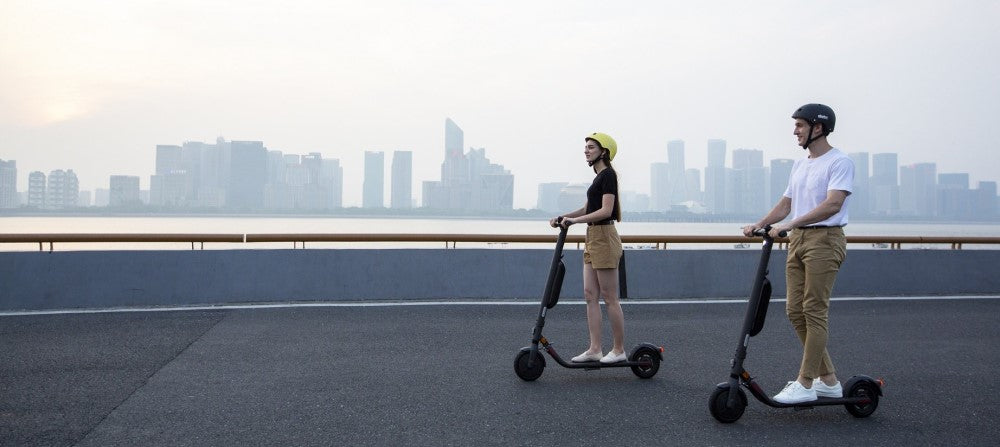
Comparison of the 3 new models E22E - E25E - E45E
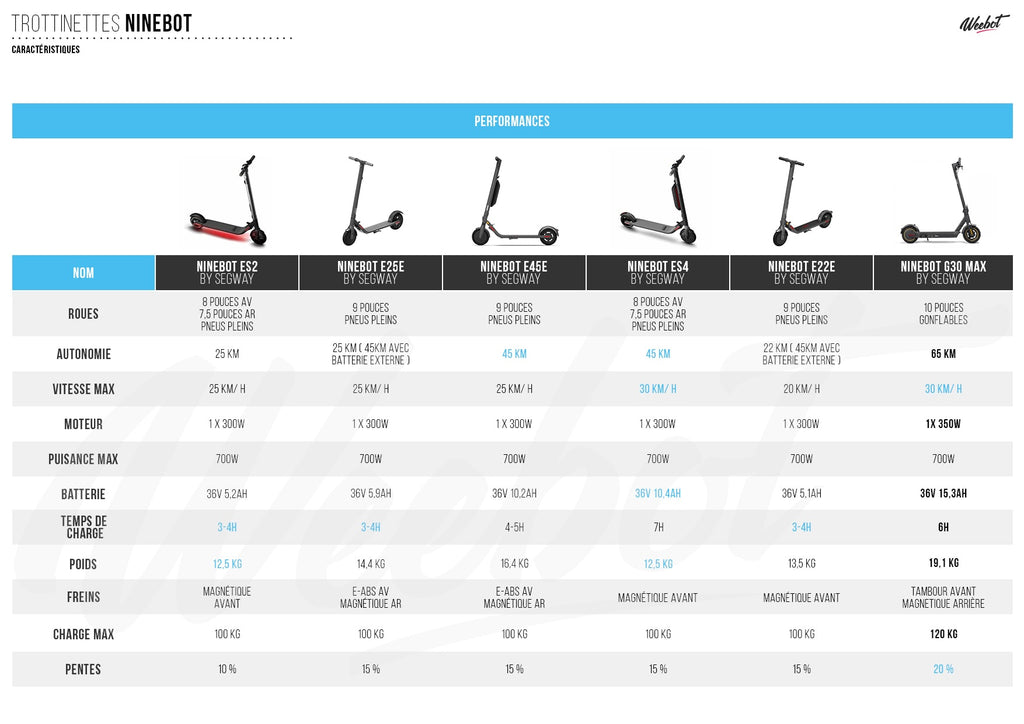
Directly replacing the excellent ES2 and ES4, the new Ninebot E22E, E25E and E45E compete with the latest Xiaomi Essential, 1S and Pro 2 electric scooters. Quite similar in appearance, this new generation resulting from the Segway-Ninebot merger still offers slight differences to better meet each user's needs.
Ninebot E22E as entry-level
Evolution of the old ES1, the Ninebot E22E is an affordable electric scooter that retains the general design of Segway-Ninebot models. Designed for exclusively urban use, Ninebot's new entry-level model is easily portable at 13.5 kg. We have even ranked it in our top 5 lightweight electric scooters.
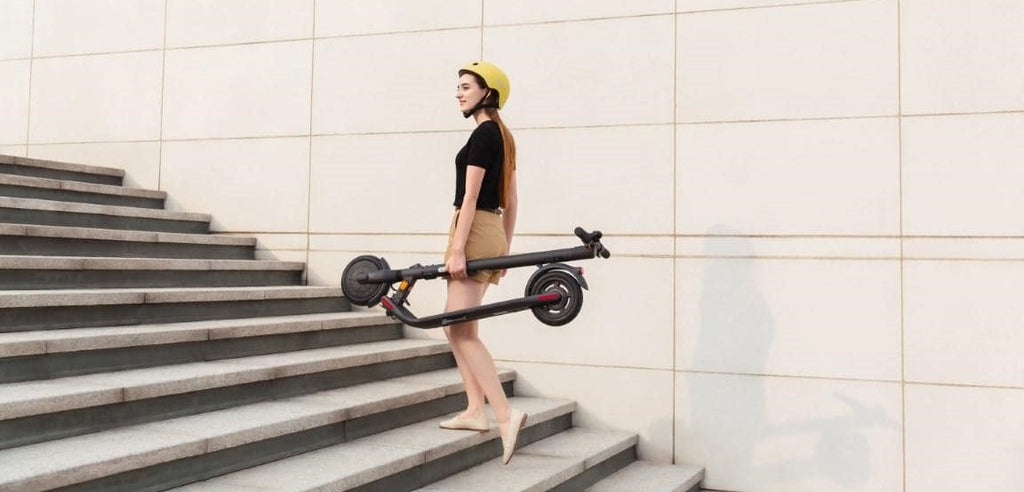
Equipped with new 9-inch solid tires, made of reinforced rubber, it allows reaching a top speed of 20 km/h. Thanks to its IPX4 certification, the Ninebot E22E will accompany you everywhere, even in light rain on your route. As with most Ninebot models, the E22E electric scooter accepts a external battery easily installable to extend the range up to 45 km for people who need to travel a bit further than average.
E25E and E45E, the game of seven differences
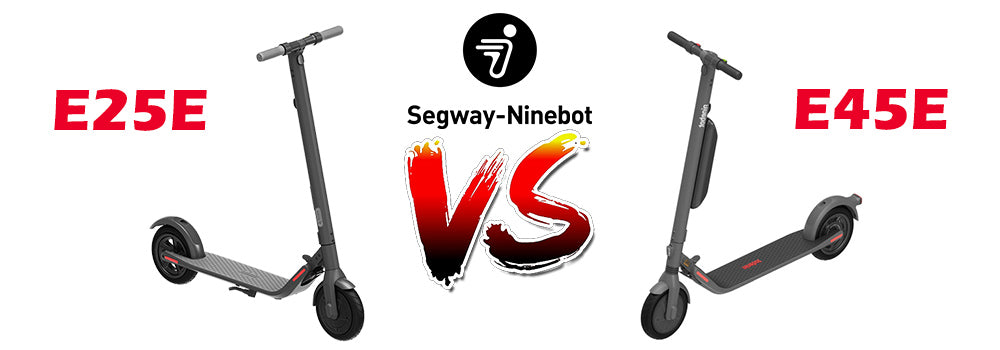
Rather very similar in appearance to the Ninebot E22E, the last two are still quite different. The Ninebot E25E and E45E are actually one and the same product. The only difference lies in the external batteryincluded from purchase on the E45E while it is only optional on the Ninebot E25E. This external battery allows you to almost double the range of the Ninebot E25E, which is limited to 25 km.
Apart from that, the two latest models from the Segway-Ninebot merger feature a 300W brushless motor offering a maximum speed of 25 km/h in accordance with current regulations. Offered at an affordable price, these Ninebot electric scooters have received the label design awardWith LED lights placed under the deck, these Ninebots are visible from afar at nightfall. Adjustable via the Segway-Ninebot app, you can choose the color of your choice to match the ambiance chosen for your night rides.
Users benefit from new reinforced 9-inch tires with the Ninebot E45E and E25E electric scooters to reduce the risk of punctures. Very comprehensive in every way, these electric scooters receive an IPX4 certification protecting them more effectively from rain.
Some clarifications on the Segway-Ninebot brand
Founded in 1999 by American inventor Dean Kamen, Segway became known for revolutionizing the world of personal transportation long before the arrival of electric scooters. By basing its devices on cutting-edge technology centered on self-balancing two parallel wheels, Segway quickly attracted worldwide attention to its products.
Today, many users are somewhat confused, no longer knowing how to differentiate between Ninebot, Segway, and even Xiaomi which has joined the equation. Let's briefly retrace the history of these companies to understand where these latest electric scooters come from.
The success of Segway in the early 2000s
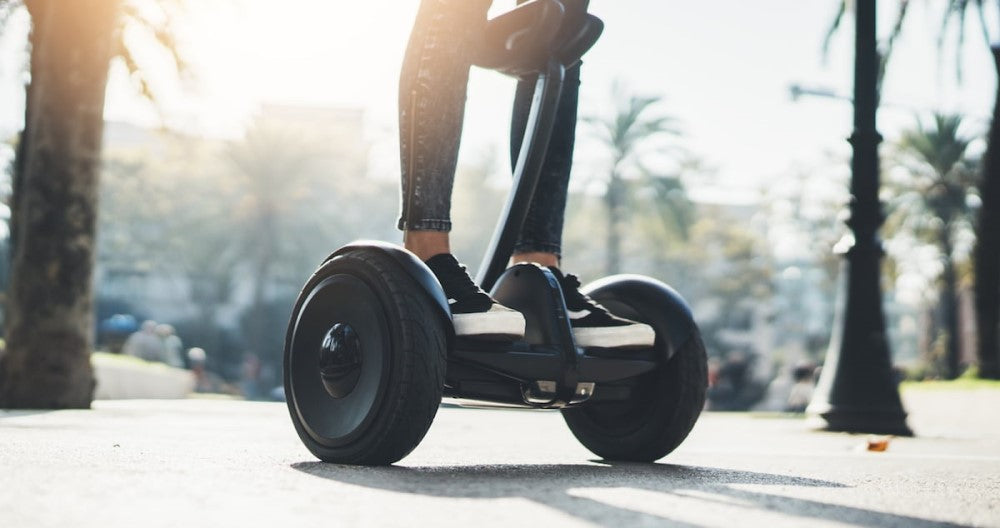
Segway received a rather enthusiastic welcome at its launch from millionaire investors who strongly believed in the future of motorized personal transportation at the dawn of the new millennium. Jeff Bezos, founder of Amazon, and the late Steve Jobs all invested in the American company Segway, which offered a real alternative to the car with its famous gyropods. In the early 2000s, we were still far from thinking about changing our urban mobility, but the idea has come a long way since then. Being able to move intuitively at a speed of 19 km/h simply by leaning your body was then a feat. Convenient for quickly transporting its user around the city in an ecological and effortless way, the gyropod promised a kind of future ahead of its time.
A tragic fate for the Segway buyout
Unfortunately, the great adventure did not continue as many had thought. Probably too ahead of its time, Segway never managed to reach its sales targets. The prices charged at the time by the American company were far from attracting the general public. We are talking about devices costing no less than 6000 to 7000 dollars. An elitist price that mainly convinced millionaires wishing to move easily in urban environments. Moreover, you needed space to store such a device at home.
Jimi Heselden, a British businessman, bought Segway in 2009 hoping to give it a new lease on life. But while testing a new product at his residence in Yorkshire, England, he suffered a fatal accident by falling off a cliff with his gyropod less than a year after the Segway buyout. A terrible stroke of fate that did not help the company to recover.
The arrival of the Chinese Ninebot in 2015
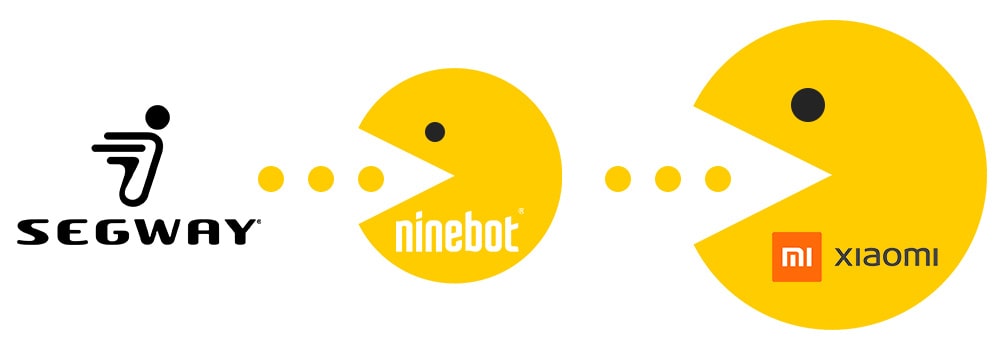
It was not until 2013 that Segway was bought by an American investment fund (Summit Strategic Investments) which immediately resold it to the Chinese competitor Ninebot. The latter had previously been sued by Segway for patent infringement. To close this chapter, Ninebot simply bought the American firm to offer a powerful alliance in the world of electric personal transportation.
Moreover, at the same time the other major Chinese company Xiaomi, known among other things for its smartphones, is entered Ninebot's capital with a nice check of 80 million to facilitate the definitive purchase of Segway. Ninebot relies on Segway's brand image as well as its famous patents to develop its range of electric scooters since the discontinuation of gyropods is now confirmed, after only 140,000 sales in 20 years. The famous device that had attracted investors and the media even before its launch, ultimately never won over the public. The production of this single-seat electric vehicle accounted for only 1.5% of Ninebot's revenue.
FAQ:
How to update my Ninebot electric scooter?
With the Segway-Ninebot app (on Android PlayStore and iOS AppStore) which gathers all Ninebot products, you can very easily update your Ninebot scooter.
What is the maximum speed of Ninebot electric scooters?
ES1: 20 km/h
ES2: 25 km/h
ES4: 30 km/h
E22E: 20 km/h
E25E: 25 km/h
E45E: 25 km/h
Max G30: 30 km/h
Is the Ninebot electric scooter waterproof?
Although Ninebot models benefit from IPX4 and IP54 certification, we advise you to ride as little as possible in rainy weather. Battery oxidation is not covered by warranty, so there is always a risk even though Ninebot scooters are among the most water-resistant electric scooters.
Is there a difference between the E25E and E25 scooters?
The E following the Ninebot electric scooter number designates a product designed for the European market.
What is the difference between Segway and Ninebot?
Since the acquisition, the manufacturer Ninebot keeps the Segway name alongside its own brand. Products branded only Segway are intended for professionals, while Ninebot products are rather reserved for individuals.
Which model does Lime use for its electric scooters in free service?
The company behind Lime electric scooter rentals is and will be, from September, one of the only three companies selected by the Paris city hall to be used by Parisians. Their devices are based on Ninebot electric scooters. Initially equipped with Ninebot ES1, Lime now uses more Ninebot ES4 like on the free-floating scooters from Jump (Uber) and Tierr.
Conclusion
An excellent way to get around, we highly recommend the latest Ninebot electric scooters which are particularly well positioned in the lightweight scooter ranges. The Chinese manufacturer offers devices with excellent build quality while providing its scooters with a level of equipment often superior to the competition. Not necessarily the fastest on the road, Ninebot mainly focuses on the ease of transport of its devices, the build quality, as well as the comfort during their use.
By offering three new models close in terms of performance to the latest Xiaomi ones, the silhouettes of Segway-Ninebot scooters are likely to be seen again on every street corner in the coming months.