
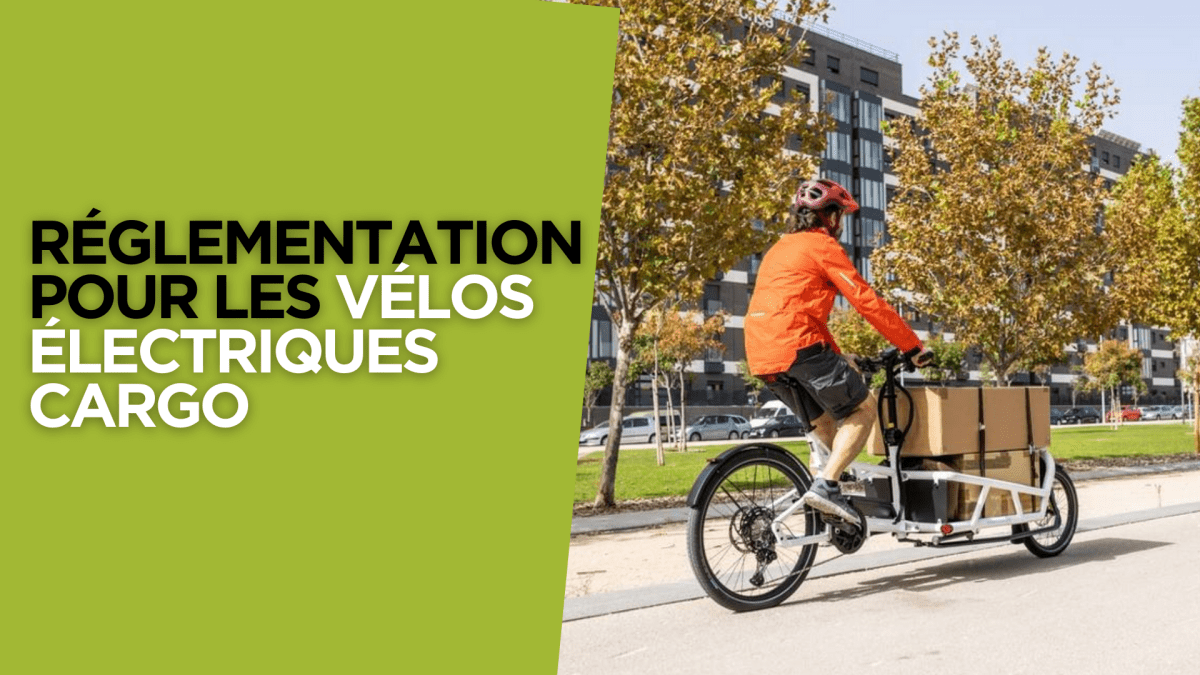
Electric bikes have experienced significant growth in recent years. They can be found in all major cities where they establish themselves as a practical and ecological alternative to combustion vehicles. Capable of transporting children and heavy loads, electric bikes are mainly aimed at large families and professionals. Faced with this enthusiasm, the authorities have no choice but to implement specific regulations aimed at controlling their use in urban areas.
In this article, we will discover its new regulations for electric bike cargo.
What is an electric bike cargo?
Electric bike cargo are gradually taking over our roads. Today used to transport our children or deliver our packages, electric bike cargo present themselves as a true ally for families and merchants.
Definition and characteristics
The electric cargo bike is a true revolution in the field of green mobility. Designed to transport passengers or heavy and bulky loads, it eases pedaling thanks to its electric motorization, even over long distances or steep slopes. On average, cargo bikes can support maximum loads of 200 kg. Some models are equipped with a front platform, others with an integrated rear trailer, allowing adaptation to different needs without losing maneuverability.
Compared to a classic electric bike, the cargo bike is larger and offers better stability. Its motor is generally more powerful to compensate for the extra weight, and its long range is perfectly suited for extended use. All these features make it an ideal choice for large families and professionals looking for a practical and eco-responsible alternative to combustion vehicles.

The most common uses
For large families, the electric cargo bike represents an effective solution to transport children safely. Equipped with approved seats and seat belts, it allows parents to carry out daily trips, such as dropping children off at school, taking them for a walk in a park, or grocery shopping, all while enjoying a practical and eco-friendly vehicle.
On the professional side, the electric cargo bike is highly appreciated for its large loading capacity, practical for making deliveries in urban areas. Environmentally conscious, many committed companies rely on this type of electric bike to transport parcels without being affected by traffic restrictions or low emission zones (ZFE).
Finally, the electric cargo bike is perfectly suited for environmentally conscious individuals. It is an ideal alternative to cars, especially for short or medium-distance trips, while reducing one’s carbon footprint and saving on fuel costs.
Electric cargo bike: growing popularity and several legislative challenges
The global electric cargo bike market has been accelerating for several years and is expected to grow with a CAGR of 3% until 2032. In Europe alone, between 400,000 and 500,000 models were sold in 2022. It is undeniable that electric cargo bikes meet a growing demand for mobility in increasingly urbanized environments.
Their popularity is also due to rising living standards and global environmental awareness. In France, the electric bike cargo market is very dynamic, with a market share multiplied by 9 and more than 35,000 units sold in 2023.
It is therefore clear that their success is no accident. As mentioned, it is driven by a collective awareness of climate issues and by sustainable mobility policies implemented in many cities. Not to mention purchase subsidies and local initiatives that have helped make this type of electric bike accessible to the widest audience.
However, this rise in popularity also raises important regulatory questions. Cities must adapt their infrastructures to accommodate these bulky bikes, notably by widening bike lanes or creating specific parking zones. The implementation of stricter safety standards is necessary to ensure harmonious coexistence with other road users.
The new regulations for electric bike cargo in 2025
The recent Babboe case somewhat accelerated the implementation of the EN 17 860 standard dedicated to cargo bikes. These standards actually began in 2017. Among the tests, a differentiation between domestic and commercial use. This is where the problem lies, as the boundary between the two sometimes does not exist. Moreover, the market of 1.88 billion euros in 2024 is expected to reach 2.73 billion in 2029. Hence the importance of the rapid implementation of these specific standards.

Maximum allowed power and speed
In 2025, regulations concerning electric bike cargo will tighten to ensure better safety on the roads. Today, motor power is limited to 250W so that they remain suitable for urban traffic. The same goes for electric assistance, which cannot exceed a speed of 25 km/h, limiting the risk of accidents in spaces shared with pedestrians.
Non-compliant bikes will face consequences that can be severe. Cyclists risk fines, or even bans from circulating in certain areas. However, some exceptions remain. Models intended for commercial use or approved for specific uses may have special authorizations, provided they meet precise conditions.
Mandatory equipment to be compliant
Cyclist safety is at the heart of the new requirements for electric bike cargo. In terms of active safety, each bike must be equipped with front and rear lighting, reflectors, as well as an effective sound warning device.
If you need to transport your children or heavy loads, passive safety is enhanced: appropriate braking, mandatory helmet wearing for children under 12 years old, and suitable seat belts are required. If you need to ride outside urban areas, at night, or when visibility is reduced, wearing a retro-reflective vest is also mandatory for the cyclist and their passengers.

Finally, for professionals using electric bike cargo for deliveries, registration or unique marking is required. This allows tracking their use and ensuring better compliance with current standards.
Traffic rules in urban areas
Access regulations to bike lanes are also clarified for 2025. Electric bike cargo must meet precise dimensions to circulate on these paths. If they exceed the limits, they must ride on the roadway alongside other motor vehicles.
In pedestrian zones and city centers, specific restrictions apply. For professionals, delivery times may be regulated to avoid peak hours. These measures aim to ensure peaceful coexistence among road users while promoting clearer logistics.
Comparison with regulations from previous years
To fully understand the new regulations established for 2025, you need to compare them with those of previous years. This will put you back in the context of the time and help you grasp the real motivations of lawmakers regarding these new rules.

Review of the rules in force before 2025
Before 2025, electric bike cargo operated under a more flexible legislative framework, inherited from general regulations on classic electric bikes. While this flexibility allowed rapid adoption of regulations, it left many gray areas.
For example, there were no specific standards regarding the supervision of models designed to carry heavy loads or passengers. Moreover, safety equipment requirements were limited, which could lead to risky situations, especially in very dense urban areas.
The lack of clear guidelines also made it difficult to integrate electric bike cargo into existing infrastructures, such as bike lanes often unsuitable for their size.
Major developments in 2025
The new 2025 regulations mark a clear break with previous years. The introduction of specific standards for electric bike cargo reflects a desire to guarantee both user safety and better regulation in urban areas. Strict restrictions on motor power and assisted speed aim to prevent abuse and avoid accidents.
Moreover, the obligation to have suitable equipment and safety devices for the transport of passengers and goods meets the requirements of large families and professionals. The new rules, such as unique marking or registration, promote traceability and better control of vehicles in circulation.
State aids and grants for the purchase of your electric cargo bike in 2025
If you are thinking of switching to an electric cargo bike in 2025, this is the ideal time to take advantage of the many aids offered by the State. Here is everything you need to know about the aid available this year, the conditions to meet, and why the State supports this type of transition.

Purchase of an electric cargo bike: What aid is offered in 2025?
In 2025, the State has strengthened grants for the purchase of an electric cargo bike to promote more ecological modes of transport and support the energy transition. These aids are part of the sustainable mobility plan defined in the Climate and Resilience law (2021), which aims to reduce the carbon footprint of the transport sector.
Individuals can receive aid of up to €2,000 for the purchase of an electric cargo bike, depending on the aid criteria (geographical area, type of bike, etc.). Professionals, for their part, can obtain an even larger subsidy, up to €3,000, for the acquisition of bikes intended for commercial uses (delivery, goods transport).
This aid is governed by ministerial decrees such as the one from May 7, 2022, which specifies the application procedures for subsidies for clean vehicles.
Why does the State offer this aid?
The goal of this aid is clear: to encourage the reduction of CO2 emissions, reduce congestion in cities, and promote more sustainable transport solutions.
By offering these grants, the State aims to make the purchase of electric cargo bikes more affordable, while contributing to better air quality in urban areas. This is part of the national low-carbon strategy (SNCB) adopted by France under European climate commitments, notably the Climate and Resilience law which requires significant reductions in transport sector emissions by 2030.
Electric cargo bikes represent an ideal alternative to combustion vehicles, especially for short trips or deliveries in the city, where traffic restrictions and low emission zones (ZFE) are increasingly common.
Until when can you benefit from it?
Grants for electric cargo bikes are available in 2025, but be aware, they are often awarded within the limits of funds allocated by the State and regional schemes. It is therefore advisable to quickly check the eligibility criteria and apply as soon as possible, as budgets may be limited and aid is not guaranteed throughout the year.
Applications must be made within the framework of energy transition aid schemes, which are subject to regular control by the Ecological Transition Agency (ADEME). For individuals, applications can be made until the end of 2025, but it is better to act quickly to not miss the opportunity.
What are the conditions to take advantage of it?
To benefit from these aids, there are some conditions to meet.
Compliance
Your bike must comply with European safety standards and meet the 2025 performance criteria. For example, the motor power must be limited to 250W, and the maximum assisted speed must not exceed 25 km/h, in accordance with European regulations on mopeds (Regulation 168/2013/EU). This compliance ensures that electric bike cargos remain safe for users and suitable for urban traffic.
Income and location
Next, the aids are often subject to income or location criteria. For example, if you live in a dense urban area or in a low-emission zone, you could be eligible for a higher amount. Similarly, professionals will need to prove the use of their bike for professional activities such as delivery or goods transport, in accordance with legislative texts related to urban logistics and low-emission zones (ZFE).
Purchase from an authorized dealer
Finally, to benefit from the aid, you must purchase a bike from an authorized dealer who meets the subsidy criteria, defined in decree no. 2021-1193 of September 15, 2021, on low-emission vehicles. Remember that some cargo bike models, especially those intended for commercial use, may be subject to specific conditions regarding registration or unique marking.
Conclusion
The new regulations implemented for 2025 govern the use of electric bike cargos, providing a safe environment for all road users. As a user, you must ensure that your equipment complies and adopt practices respectful of the legislation to fully enjoy the benefits of the electric bike cargo.
If you feel ready to embark on the electric bike cargo adventure, take a look at our Weebot shop. We will help you choose the model suited to your needs and expectations. And don’t forget, you can benefit from state aids and subsidies for the purchase of your electric bike cargo. Don’t hesitate to apply to save money.